South Africa rarely tops anyone’s Tier-2 shortlist. Most affiliates running Facebook traffic default to Southeast Asia or LATAM, and that’s part of why ZA works so well for those who do commit to it. Less competition, strong English penetration, and solid conversion rates on interactive formats.
This case study comes from Peter Yang, a partner from China who has been running Zeydoo offers since 2019, starting with Finance and moving to today’s Interactive offers. In December 2025, he ran 5 parallel Facebook campaigns on Zeydoo Clickbox in South Africa.
Total spend came to $5,257, total revenue to $6,702, with a blended ROI of 27.5% and one campaign hitting 91%.
The numbers are in the table below. The more useful part is the system behind them: how Peter finds angles, structures tests, manages creatives, and keeps the operation stable enough to replicate across multiple GEOs simultaneously.
Campaign Results
Final performance across 5 campaigns
Why South Africa?
South Africa has roughly 62 million people, with 67% urbanization. There are 11 official languages, but English functions as the universal language of business and media, so campaigns can launch without heavy localization. Beyond English, Afrikaans, Zulu, and Xhosa are the most widely spoken, which matters for the Ad Library research phase covered below.
From a buying power standpoint, South Africa is one of the most economically developed countries in Africa. Facebook is the dominant social traffic source in the country, and local users respond well to both entertainment-style and utility-style Interactive offers.
The combination produces strong conversion rates at competitive CPMs for affiliates willing to look past the more obvious Tier-2 defaults.
Campaign Overview
| Detail | Info |
|---|---|
| Traffic Source | Facebook Ads |
| Offer | Playable |
| GEO | South Africa (ZA) |
| Campaign period | December 2025 (01/12–31/12) |
| Campaigns number | 5 |
| Total spend | $5,257 |
| Total revenue | $6,702 |
| Net profit | $1,444 |
| Blended ROI | 27.5% |
| Best campaign ROI | 91% |
| Bid strategy | Lowest Cost / Cost Cap |
| Starting daily budget | $5 per campaign |
Note on data: Revenue figures come from Zeydoo’s dashboard. Minor discrepancies in Facebook’s reported spend may occur due to differences in postback timing.
Process: Testing and Optimization
Testing and Optimization
A compact flow from creative research to scaling.
Spy Winning Ads
Search Facebook Ad Library in local languages and look for advertisers running multiple ads for 7+ days.
Build Variants
Use the winning angle as inspiration and generate multiple AI creative variations for testing.
Test & Scale
Start new creatives in 1-2-3 or 1-1-3. Move winners into 1-1-1 and scale.
Optimize
Exclude converters, build Lookalikes, and rotate offers by CR and payout stability.
Spy First, Then Build
Before entering a new GEO, Peter checks the Facebook Ad Library to see what’s already working. One important trick: they search in the local language, not English.
“Terms like ‘win’ rarely surface the real winners, because top-performing ads on Tier-2/3 GEOs use local-language copy to pass FB review and resonate with users. So I translate the keyword into the GEO’s primary local language first – Afrikaans or Zulu for ZA – then search.”
Peter looks for advertisers running several ads at the same time, with at least one ad live for 7+ days. If an ad stays active that long, it’s usually making money.
After finding a good creative, Peter uses it as inspiration for AI image generation, creating 10+ variations from the same idea to test quickly.
Two Structures for Two Situations
Not all creatives enter testing the same way. Validated creatives – ones that have already proven themselves in another GEO or an earlier test – go straight into a 1-1-1 structure:
- One campaign, one ad set, one ad
- High daily budget
- 2-3 days without edits
Unvalidated creatives start in a 1-2-3 or 1-1-3 setup:
- One campaign, two or three ad sets, three ads, running in parallel at low spend
- Once an ad set produces consistent conversions, it gets duplicated into a 1-1-1 structure and scaled.
Two Structures for Two Situations
Use a simple structure for proven creatives, and a testing structure for new ones.
Go Straight to Scale
- Use when the creative already worked in another GEO or earlier test.
- Set a higher daily budget.
- Leave it alone for 2-3 days so the algorithm can learn.
Test Before Scaling
- Run several ad sets or ads in parallel.
- Keep the budget low while testing.
- Duplicate the winning ad set into 1-1-1 once conversions are stable.
Peter never launches a new GEO with a large budget. The rules are simple:
- Start with a $5 daily budget
- Increase the budget by no more than 20% at a time
- Make no more than three edits per day
If you increase the budget too quickly or change settings too often, Facebook resets its learning phase. When that happens, the algorithm loses the optimization it has built from previous conversions, which can increase costs.
Creative Rules That Reduce Risk
Copy stays short and avoids anything that reads as aggressive. This might trigger Facebook’s review system before a campaign builds any momentum.
Here’s one good example:

Two other rules apply consistently:
- The copy and the creative image need to match – the same scenario across both. When they do, users engage and leave comments and reactions, which gives the ad more weight in the auction. When they do not match, CTR drops and CPM climbs
- A visible button element inside the static or video creative consistently improves CTR across every GEO Peter runs.
Budget and Audience Management
Once a campaign accumulates 500 to 1,000 conversions, Peter starts excluding converted audiences and users who have already engaged with the Page. Also, he monitors the ad frequency. Running the same ad repeatedly to the same people inflates CPM without producing new conversions.
For Lookalike audiences: Peter does not rely on them until the seed audience reaches 5,000 conversions. Below that threshold, the seed is too thin to produce reliable results. Testing Lookalikes earlier is not wrong, but expecting them to solve a scaling problem before 5,000 conversions is.
Three-Offer Rotation
Rather than committing all traffic to one offer, Peter runs three Clickbox offers simultaneously within the same vertical.
Traffic weight shifts based on real-time CR and payout stability. When one offer’s performance drops, whether from a product-side change or audience fatigue, the rotation absorbs it.
This is also why payout stability matters more than headline payout rate when committing serious Facebook budget. As Peter puts it:
There are various survey-style products, but their CR/payouts swing too much week-to-week, which breaks FB unit economics. Zeydoo Clickbox holds steady, which is what lets me commit real budget.
What if it doesn’t work?
A losing ad isn’t always a dead ad. If a campaign reaches -20% ROI, Peter doesn’t shut it down immediately. Instead, he tests new creatives, adjusts targeting, or tries a different bidding strategy to improve results.
The goal is not to save every ad, but to keep the account moving in the right direction overall.
Results and Key Takeaways
Final Numbers
- Spend: $5,257
- Revenue: $6,702
- Net profit: $1,444
- Blended ROI: 27.5%
- Best single campaign ROI: 91%
- Total conversions: 19,148 across 5 campaigns
Campaign Breakdown
The 5 campaigns ran at different scales, which is shown directly in the results.
The two largest campaigns (#1 and #2) generated the bulk of revenue and ran at 24.1% and 32.7% ROI, respectively.
Campaign #5 was the smallest by spend – $138, but returned 91% ROI, the highest of the month.
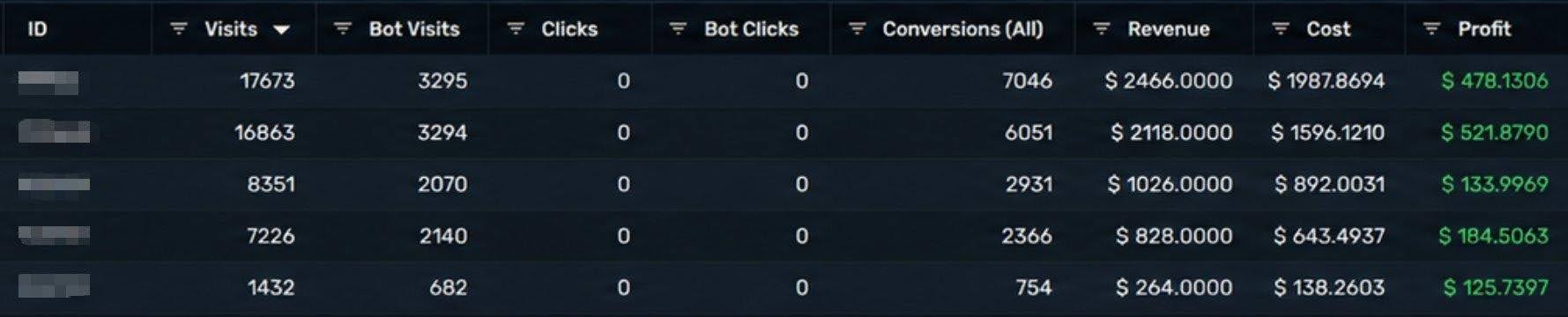
Note: Bot visits (682–3,295 per campaign) are excluded from conversion counts. Zeydoo’s dashboard tracks and filters bot traffic separately.
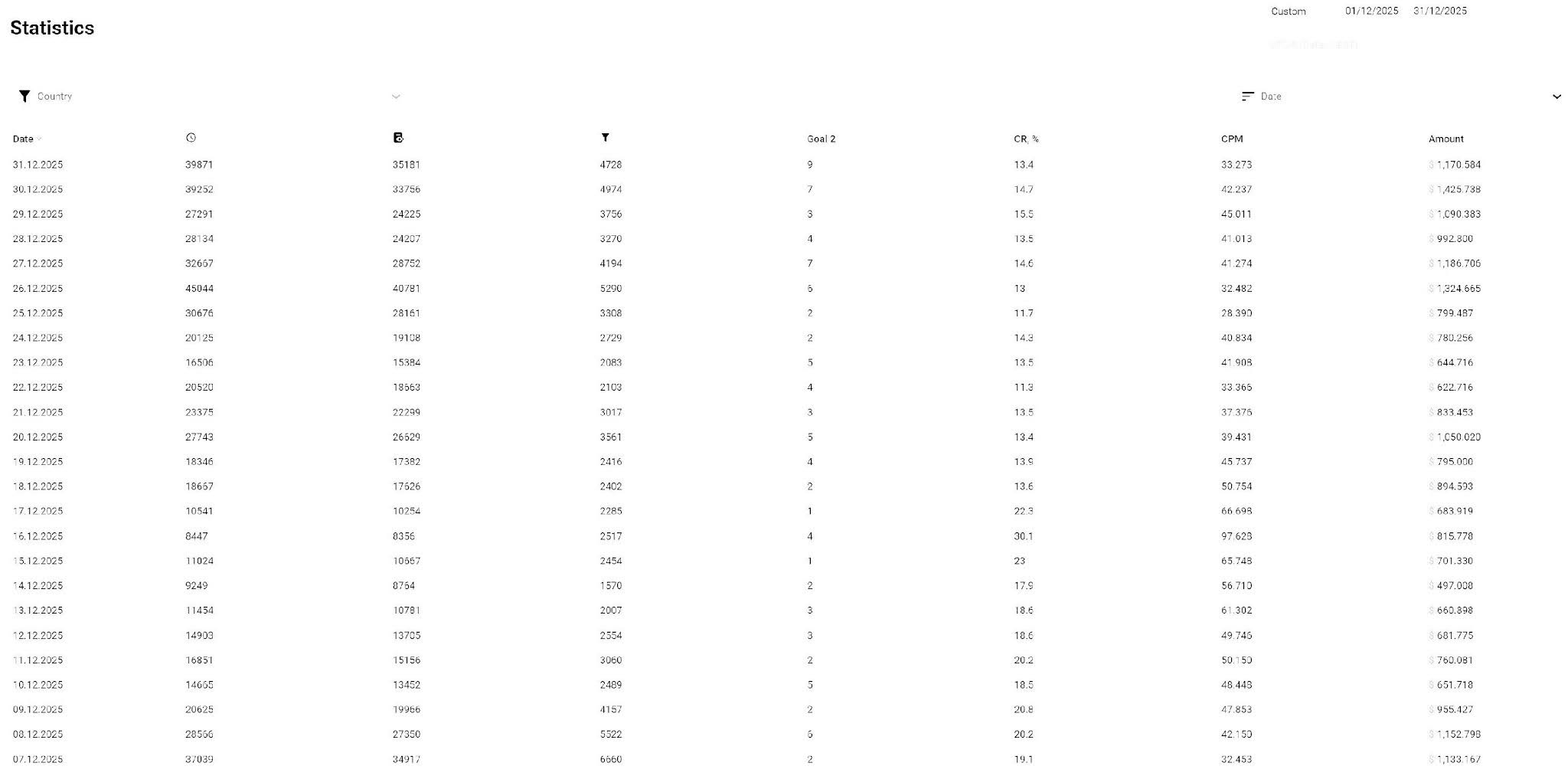
The effective CPM earned from Zeydoo (revenue per 1,000 visits) varied significantly across campaigns:
- Campaign #5 earned the highest at $184 per 1,000 visits – a smaller audience producing higher-quality engagement.
- Campaigns #1 and #2, running at much higher volume, earned $140 and $126, respectively.
This pattern holds across the daily stats as well: early December, when volume was lower, earned CPMs of $56–97. By late December, as volume scaled, the blended CPM settled in the $32–45 range:
Lessons Learned
- Search in the local language, not just in English. The Facebook Ad Library shows different ads depending on the language you use for search. In Tier-2 and Tier-3 GEOs, many of the best-performing campaigns use local-language copy. For example, searching in Afrikaans or Zulu in South Africa can reveal winning ad angles that do not appear in English searches.
- AI makes creative testing faster. One successful ad can be turned into multiple new variations with AI image-generation tools. Instead of creating every creative from scratch, media buyers can start with a proven concept and quickly build enough variations to test different ideas.
- Do not rush to change winning campaigns. The 1-1-1 setup worked because it gave Facebook enough time to learn. Once a campaign starts getting conversions, making constant changes can interrupt optimization and increase costs. Sometimes the best move is simply to leave a campaign alone for a few days.
- Every conversion has value. Conversion data helps Facebook understand who is most likely to take action. Even campaigns that are not yet profitable contribute valuable data for future optimization and Lookalike audiences. Stopping them too early can slow down long-term growth.
- Do not rely on a single offer. Running multiple offers simultaneously makes campaigns more stable. If one offer’s conversion rate drops or the payout changes, traffic can be redirected to another offer without disrupting overall performance.
- Facebook traffic and Playable offers are a natural match. Playable ads from Zeydoo are built around interactive, game-like experiences – exactly the type of content Facebook’s algorithm rewards with lower CPMs and higher reach. Users engage with the creative before they even click, which means they arrive at the offer already warmed up. This reduces the gap between impression and conversion and improves overall traffic quality.
Comment from Karina Arkhangelskaya, Zeydoo Sales Director:
Successful media buying is a system. The way it’s built defines your results as much as the offer does and is equally important.If you haven’t built your own approach to testing yet, Peter’s example is a great starting point!
To Sum It Up
December 2025 was just one snapshot of a strategy Peter has been running since 2019. South Africa is only one of several GEOs they work with, alongside Brazil, Indonesia, Vietnam, and the Philippines.
For Peter, the goal is not to maximize profit from a single campaign. The goal is to build a process that they can repeat again and again across different markets.
The December numbers are a good example of that process in action.
Want to test the same format?
Check out Clickbox offers 19037 and 20418 on Zeydoo with Facebook traffic, build your own testing framework, and see what works for your traffic.