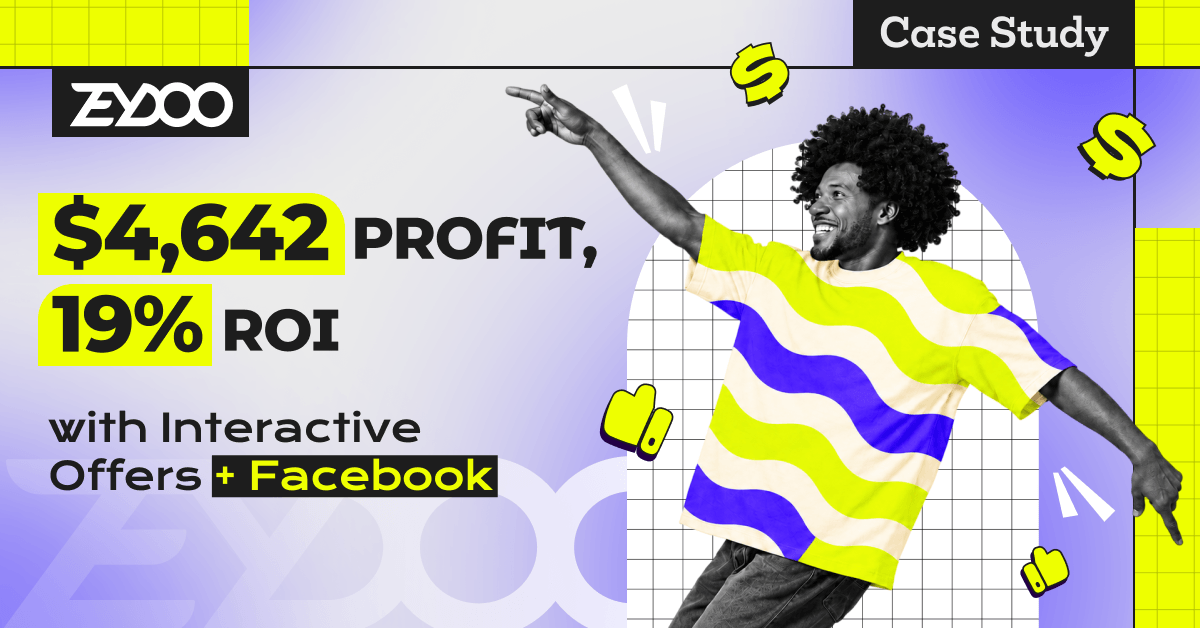
How a three-person crew scaled Zeydoo Fixed CPL offers from $123 test budgets to $2,500 a day on Facebook
Our partner leads a three-person media buying crew, and the division of labor is the first thing he mentions when asked how the operation works. He’s on strategy and testing; his partner is on infrastructure (business managers, agency accounts via standard Meta partners), and the full-time designer makes sure there are always enough creatives to test.
He didn’t come into affiliate marketing on purpose. First, he spent three years doing performance marketing for SaaS startups, then a friend pulled him in. After a while in the field, the team decided to bet everything on Facebook.
They had tried Google and TikTok the year before, and neither returned as much per dollar spent as running Meta. So it wasn’t about liking the platform, but mainly about where the numbers worked.
Southeast and South Asia became the main focus for the same reason: CPMs are cheap, people there are mobile-first and quick to click, and that fits the funnels the team had already built.
Table of contents
Why Zeydoo + Facebook
He was skeptical about Zeydoo at first, having written it off as just another smartlink network, and it took a friend’s stats to change his mind. The EPC on that account was running noticeably at double what he was seeing elsewhere, which was enough to get him testing. The first campaign turned green on day four.
Then came a bigger decision: he moved the whole team to the Fixed CPL model (Clickbox). The main reason is that a fixed payout makes fast scaling safe. When you go from $300 a day to $1,500, you can’t afford to find out mid-ramp that your payout is being shaved.
The second reason is how Facebook learns. Simple CPL events train the algorithm faster than deeper conversion events do. That quicker feedback is what lets the team push budget as fast as they do.
Fixed CPL is the safety net that keeps your unit economics from collapsing during a spike.
Performance Snapshot
- GEOs: Tier 3, Asia and Africa
- Traffic: Facebook Feed and Reels
- Run length: 18 days
- Spent: $24,434 (traffic spend)
- Revenue: $29,076 (generated on Zeydoo offers)
- Profit: $4,642 (net)
- ROI: 19%
- Offer: Zeydoo Fixed CPL, Clickbox 20418
Peak daily spend hit $2,500. One Asian GEO carried the campaign, growing from a $123 test into the main revenue engine within a week before settling into a stable daily budget.
The flow itself is deliberately simple: Facebook Feed and Reels, into a pre-lander, into a Zeydoo Fixed CPL offer.
The Scaling Blueprint
Placements are paid only: Feed and Reels, and the team intentionally avoids organic groups. The volume that comes through them is unpredictable, and the traffic quality is inconsistent enough to distort testing, which makes it more trouble than the cheap reach is worth.
Everything past that point runs to a fixed four-step process.
- The test. CBO (Campaign Budget Optimization) is a Facebook setting where you set one budget for the whole campaign instead of a separate budget for each ad set. The algorithm then splits the money between ad sets on its own, pushing more of it toward the ones that perform better.) So for the test, they set the CBO at $80 to $120 a day, with four to six ad sets running different angles against each other.
- The hard cut. Any ad set sitting below -50% ROI after 24 hours and at least 30 clicks gets killed rather than nursed.
- The push. Winners are duplicated into fresh CBOs at three times the budget, and for serious scale, the team switches to ABO (ad set budget optimization, where the budget is set per ad set rather than per campaign) with manual bid caps, lifting daily spend by 25% at a time.
- The data loop. Everything is fed back to Meta through S2S and CAPI (Conversions API, which sends events to Meta from the server instead of the browser). He considers this step non-negotiable.
Without this data loop, it’s like gambling with Mark Zuckerberg’s money; you’re just scaling blind.
What Is Actually Converting
Creative is where most of the work goes, and the format carrying the campaign is raw user-generated content:
- Vertical video
- 12-18 seconds long
- Shot with native speakers rather than dubbed or subtitled after the fact.
In Asian GEOs, that last choice is worth getting right: 76% of shoppers prefer to buy when product information is in their own language (CSA Research, 2020).
Interactive quizzes serve a different purpose. The 3-step flows take longer to optimize than a straight pre-lander does, but they hold up past 10 days without the creative fatigue that kills most Facebook campaigns in their second week. That’s why the team uses them once something is already working and needs to keep running, not during early testing.
They keep the tech stack intentionally small. Pre-landers load in under 2.5 seconds, and everything is built for Android, because in these GEOs the team doesn’t test iOS at all.
3 Takeaways From the Lead
Asked what he would tell someone trying to run the same offer, he came back with three things.
The first is about localization. Without native-quality creatives in the local language, you hit a ceiling you cannot buy your way past, and hiring a local voice actor pays for itself within a day.
The second is about timing. He treats Fixed CPL as a scaling tool rather than a starting point, something you move to at the exact moment you are about to push budget hard, and your economics are most exposed.
The third is the one he is most insistent about, and it is the reason a 19% ROI campaign is worth writing up at all.
Don’t be the guy chasing 60% ROI on $100 a day. I’d take 19% ROI on $25k spend any day of the week. It’s more stable, it builds better data, and it puts more real cash in the bank.
What Comes Next
The team is currently cloning the successful setup for other Asian GEOs, and testing longer-form quiz prelanders against the shorter ones to push back on CPM inflation before it eats the margin.
This case reflects the results of one team’s single campaign and is not a rate card, forecast, promise or guarantee of earnings. Individual results vary significantly depending on GEO, traffic source, creative quality, offer demand, and execution.